Rosebank guide · Start here
The Complete Guide to Rosebank, Johannesburg
The foundation of everything in this section — how the district is laid out, how to move around it, and how it compares with elsewhere in Johannesburg.
Where Rosebank actually sits
Rosebank is a suburb in the northern part of Johannesburg, roughly 5km from the city's central business district and about 25km from O.R. Tambo International Airport. It's bounded by Parkwood to the west, Melrose and Melrose Estate to the east, Parktown North to the north, and Saxonwold to the south — a compact patch of the city, easy to cross on foot once you're oriented, and close enough to Sandton (one Gautrain stop) and Melrose Arch (a short bus ride) that neither feels far away.
Two roads do most of the work of connecting it to the rest of the city: Oxford Road runs north–south directly through the suburb, and Jan Smuts Avenue runs alongside it, both linking Rosebank to neighbouring suburbs and onward into central Johannesburg. If you're getting oriented for the first time, those two roads are the mental map worth holding onto — most of what matters in Rosebank sits along or just off one of them.
A short history
Rosebank's story starts a long way from the district you'd recognise today. The land was originally part of a farm called Rosemill Orchards, and it was subdivided and sold off as residential plots from 1896 onward. In 1919, the City Council renamed the area's streets after English towns, universities and British admirals from the First World War — which is why so many Rosebank street names still carry that distinctly English, early-twentieth-century flavour today.
For decades afterward, Rosebank remained a fairly quiet residential suburb on the edge of the city, with little to distinguish it. That changed from the final years of apartheid onward, as creative businesses, galleries and major companies began relocating out of the Johannesburg CBD into Rosebank and the other northern suburbs. Rosebank Mall opened in 1976 and became an early anchor for that shift; the Everard Read Gallery relocated to the area not long after; and in time Rosebank became home to the national headquarters of several major South African banks and the local headquarters of Anglo American. The more recent addition of Keyes Art Mile continued that same trajectory — a suburb that quietly transformed from residential backwater to one of Johannesburg's genuine commercial and cultural centres over the course of a single lifetime.
How the district is laid out
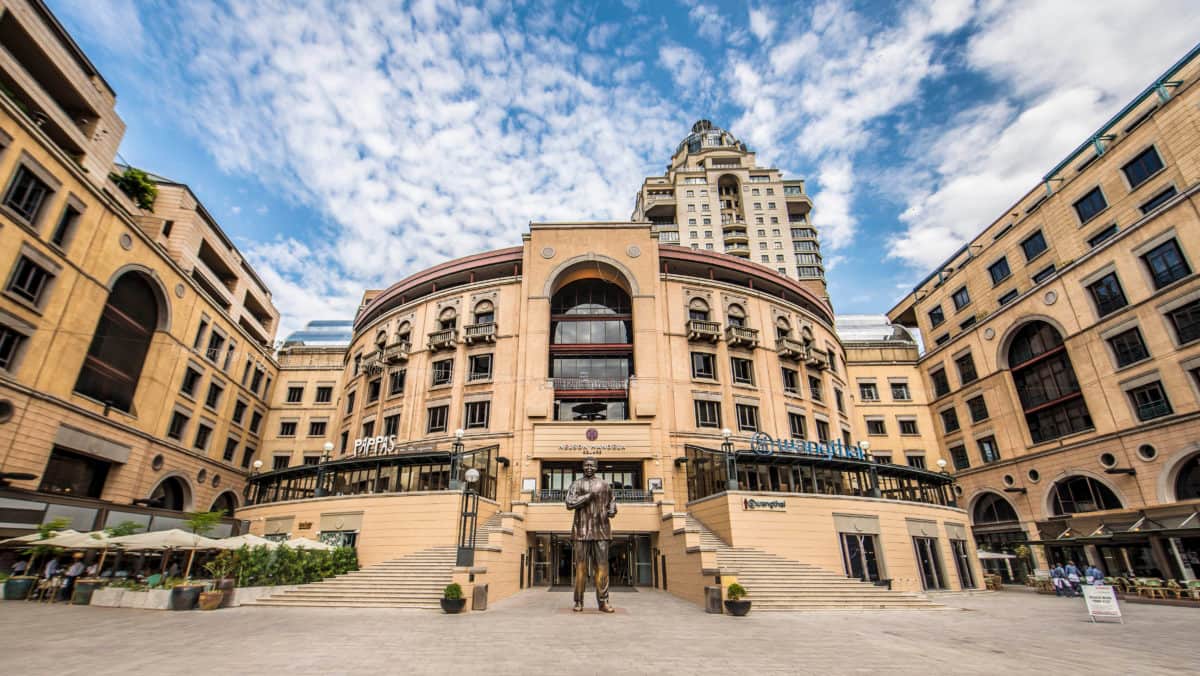
Rosebank's practical centre of gravity is The Zone @ Rosebank and the adjoining Rosebank Mall, both opening directly onto Oxford Road and the Gautrain station beneath it. This is where most day-to-day life happens — grocery shopping, cafés, casual dining, and the everyday errands covered in our Settling In guide. A short walk further along, The Firs offers a smaller, slightly more upscale cluster of restaurants, while Keyes Art Mile on Keyes Avenue combines Rosebank's most serious galleries with some of its best dining — all covered in detail in our Where to Eat guide.
Beyond the commercial core, Rosebank is genuinely residential and leafy in a way that surprises first-time visitors expecting a purely commercial district — tree-lined streets, low-rise apartment blocks and freestanding houses sit within a few minutes' walk of office towers and the Gautrain, which is a large part of why it feels lived-in rather than purpose-built for visitors.
Getting around
Rosebank's own Gautrain station sits on the North–South line, putting Sandton about four minutes away by direct train and central Johannesburg and Pretoria within easy reach beyond that. For the airport, you'll change trains at Sandton — full detail on both the station itself and the airport transfer is in our Rosebank Gautrain Guide and Rosebank to O.R. Tambo guide.
Within Rosebank itself, walking covers almost everything that matters — The Zone, Rosebank Mall, The Firs and Keyes Art Mile are all within a ten-minute walk of each other, and the district is genuinely pedestrian-friendly in a way that isn't true of every part of Johannesburg. For trips slightly further out — Melrose Arch, Hyde Park, Illovo — Gautrain's feeder buses run on weekdays using the same card as the train.
What Rosebank is good for
Rosebank does double duty better than most Johannesburg suburbs: it's dense enough with coworking space, serviced offices and direct rail access to Sandton to work as a genuine business base (see our Business Travel theme), while also having enough restaurants, markets and galleries to be worth staying in for reasons that have nothing to do with work (see Food & Lifestyle). For anyone staying more than a few days, its full-size supermarkets and everyday infrastructure make an extended stay genuinely comfortable rather than a compromise — covered in our Long Stays theme.
Who Rosebank actually is, day to day
Property listings tend to describe Rosebank as "cosmopolitan" and leave it there, but the texture is worth spelling out. It's a genuine mix: young professionals working in the coworking spaces and office towers, an established design and gallery crowd around Keyes Art Mile, families who've lived in the surrounding residential streets for years, and a constant flow of business travellers and tourists passing through via the Gautrain. That mix is a large part of why Rosebank doesn't feel like a district built for any one type of visitor — it was a real neighbourhood first, and the commercial layer grew into it rather than the other way around.
Practical basics
English is the working language throughout Rosebank and Johannesburg generally, and South Africa's currency is the rand (ZAR) — the country runs heavily on card payments day to day, with cash mainly useful for small independent traders at markets. The local time zone is South African Standard Time (SAST), UTC+2 year-round with no daylight saving adjustment, worth knowing if you're coordinating calls across time zones during a business trip.
On safety: Rosebank's core commercial precinct — The Zone, Rosebank Mall, Keyes Art Mile — carries a visible security presence and is considered one of the more comfortable parts of Johannesburg to walk around, including into the evening. As with any large city, ordinary situational awareness matters more once you're outside the main pedestrianised areas or after dark, and a short e-hail rather than a walk is the sensible default for longer or unfamiliar routes at night.
Johannesburg's climate is worth planning around too: warm, often thundery summers from roughly October to March, and dry, sunny but cool-to-cold winters from June to August, with evening temperatures dropping more than visitors expect from a city at this latitude — a function of Johannesburg's high altitude rather than a typically African climate. Pack at least one warm layer if your visit falls in winter.
How it compares to the rest of Johannesburg
The comparison most people actually reach for is Sandton — Johannesburg's larger, denser financial capital one Gautrain stop north — or Melrose Arch, the smaller, curated dining-and-hotel precinct between the two. Rosebank tends to sit in the middle on both counts: quieter and more affordable than Sandton without losing the connectivity, and larger and less manufactured-feeling than Melrose Arch.
The distinction that matters most in practice is what each area was built for. Sandton was built to be Johannesburg's financial address, and it shows — glass towers, a shopping centre among the largest in the Southern Hemisphere, and a district that empties out once the working day ends. Melrose Arch was built as a single managed precinct from the ground up, which gives it its polish but also its smaller scale. Rosebank is the one of the three that grew organically over more than a century, from farmland to residential suburb to commercial and cultural district — and that history is exactly why it still functions as a real neighbourhood rather than a district engineered for a single purpose. Our Choosing Your Johannesburg Base theme covers both comparisons in full detail.
New to Johannesburg entirely? Rosebank's smaller scale, walkability and mix of everyday neighbourhood life make it one of the easier parts of the city to get oriented in on a first visit — while still being a short train ride from everywhere else worth seeing.
Explore the rest of this guide
Everything else in this section builds on the orientation above. Here's where to go next, depending on what you need:
- Getting Around RosebankGautrain, transfers and feeder buses
- Business Travel RosebankCorporate stays, coworking and meeting rooms
- Long Stays RosebankThe economics and logistics of staying longer
- Choosing Your Johannesburg BaseRosebank vs Sandton vs Melrose Arch
- Food & Lifestyle RosebankDining, markets and weekend culture
Quick facts
Stay in Rosebank
Put yourself at the centre of it.
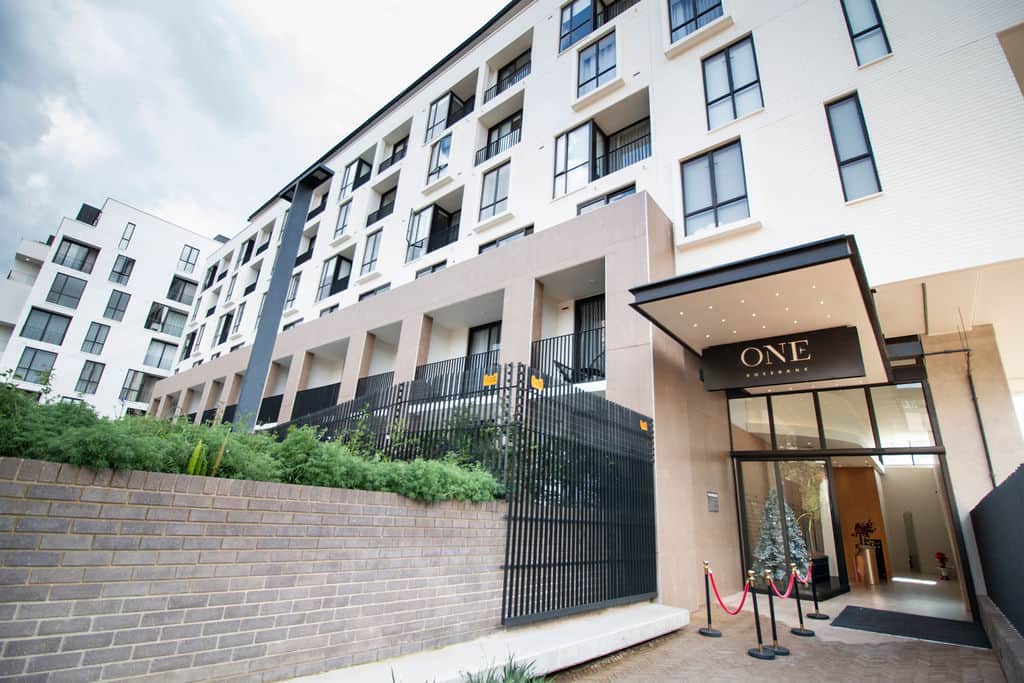
Stay at One Rosebank with Aurea Via — a serviced apartment base close to Johannesburg's business, dining, transport and lifestyle destinations.